

• Free Guide · 2026 · دليل مجاني
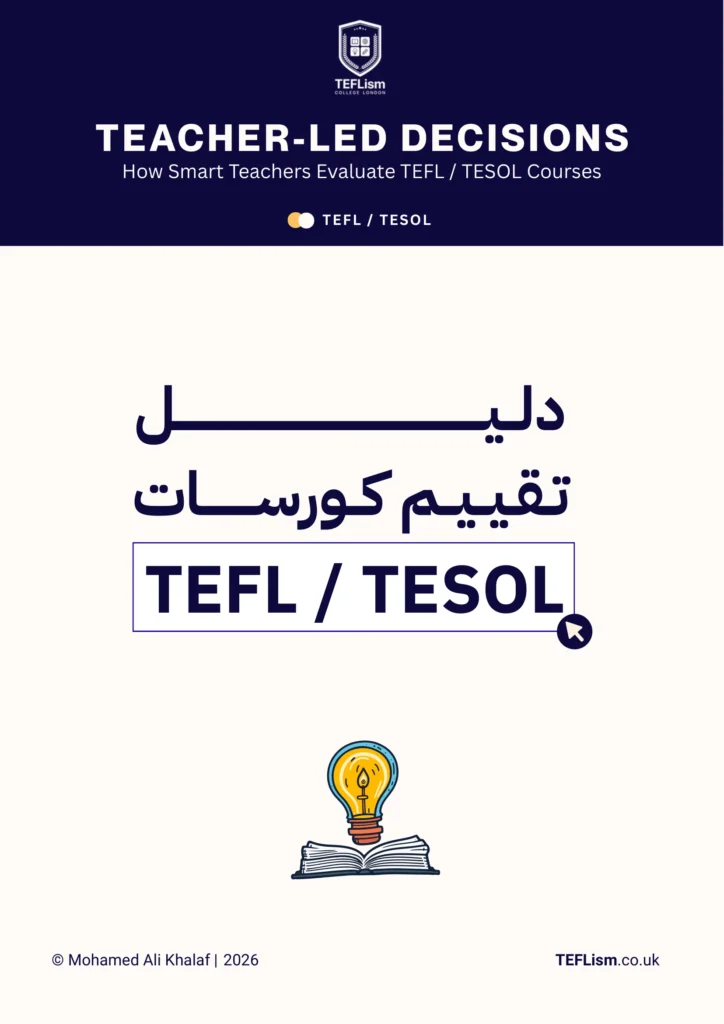
Teacher-Led Decisions
How Smart Teachers Evaluate TEFL / TESOL Courses
A frank, experience-backed guide for Arabic-speaking teachers navigating the world of TEFL/TESOL certification — written to protect your time, money, and teaching career.
- ~30 Pages
- 100% free — no sign-up
- Written in Arabic
Is This Guide For You?
Who should read this guide?
This guide speaks to a specific kind of teacher. See if you recognise yourself in any of the three below.
A Teacher at a Crossroads
You’re an Arabic-speaking English teacher seriously considering TEFL or TESOL certification, but feel lost in a sea of marketing claims and conflicting social-media advice.
The Cautious Investor
You’ve worked hard to save for a course. You refuse to lose your money on a certificate that looks impressive on a website but means nothing to real employers in the market.
The Independent Thinker
You don’t want to be swayed by social media hype or emotional posts. You want a clear, logical framework to reach your own decision — calmly and confidently.
A Teacher at a Crossroads
You’re an Arabic-speaking English teacher seriously considering TEFL or TESOL certification, but feel lost in a sea of marketing claims and conflicting social-media advice.
The Cautious Investor
You’ve worked hard to save for a course. You refuse to lose your money on a certificate that looks impressive on a website but means nothing to real employers in the market.
The Independent Thinker
You don’t want to be swayed by social media hype or emotional posts. You want a clear, logical framework to reach your own decision — calmly and confidently.
Inside the Guide
Four axes.
One clear decision.
The guide is structured around four evaluation axes — each designed to arm you with the specific questions that matter most before committing to a course.
1
Course Structure & Trainers
Who are the trainers? What are their qualifications? How is the programme designed — from the first session to the last?
2
Practical Application (Teaching Practice)
How many real teaching sessions does the course include? Is there written, structured feedback — and can you track your own progress over time?
3
Certificate & Accreditation
Is the qualification genuinely recognised by employers — or is “internationally accredited” simply a marketing phrase?
4
Institution Reputation & Philosophy
Transparency, refund policies, post-course support, and whether the institution treats you like a person before and after payment.
Red Flags Guide
Real warning signs to spot before you hand over your money — fake urgency, vague answers, post-payment silence, and more.
D-Exercise Worksheet
A printable evaluation tool to compare courses side-by-side using real information you gather yourself.
Key Takeaways
"Accredited" Doesn't Always Mean Accredited
Many providers use the word loosely. Some “accreditations” are paid memberships to commercial bodies — with no real quality oversight whatsoever.
A Certificate Is Not the Same as Becoming a Teacher
The gap is real and often enormous. Ask exactly how many teaching practices the course includes — and demand specifics, not vague reassurances.
There Is No "Best Course" for Everyone
One size does not fit all. The right course depends on your schedule, your goals, your level — and what matters most to you and your career.
How They Treat You Before Payment Tells You Everything
An institution’s behaviour before you pay is a direct preview of how they will treat you once they have your money. Watch carefully.
Read Now · اقرأ الآن
Your next teaching decision starts here.
Open the interactive guide and work through it at your own pace. It’s entirely free — no registration, no strings attached.